

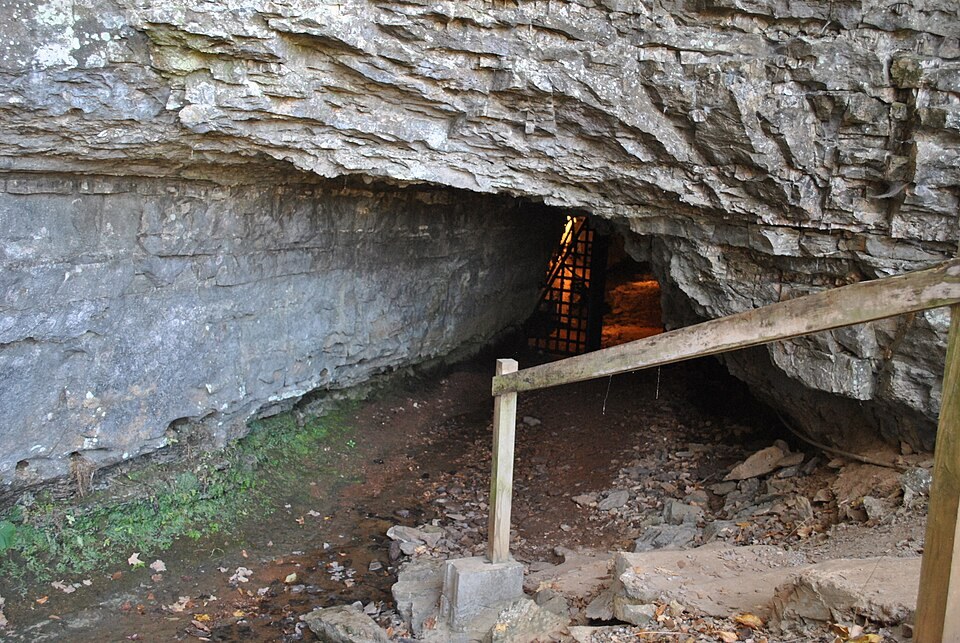
ADAMS, TENNESSEE — A cave opening in the limestone countryside has become a doorway into one of America’s most enduring ghost tales. The Bell Witch story begins with a family farm and accounts of knocks, voices, and an unseen tormentor. The cave is part of how that legend is encountered today, but the older story and the modern attraction are not identical.
HAUNTED COUNTRY ROADS · October 27, 2026 Facebook feature · Expanded for the CRE website, October 31, 2026
Lead photograph: Www78, October 2010 / Wikimedia Commons, CC BY-SA 3.0. Source photograph; web-sized copy proportionally optimized.
Before There Was a Cave Tour
John and Lucy Bell moved from North Carolina to the Red River area of Tennessee in 1804. The family developed a farm in a landscape that later became the setting for a famous haunting tradition.
In familiar accounts, disturbances began around 1817. The Tennessee Encyclopedia describes the chronology somewhat differently, beginning the unusual events around 1816. That variation is a reminder that a frequently repeated legend does not always arrive with one consistent timeline.
Stories describe strange noises, a speaking presence, physical disturbances, and particular attention directed toward John Bell and his daughter Betsy. The entity became known as Kate or the Bell Witch. These descriptions belong to the reported tradition; they are not direct observations made by CRE.
The Voice in the House
The most distinctive element of the Bell Witch narrative is not a visible ghost. It is a voice: answering people, arguing, imitating others, and intruding into family life.
Versions differ over the identity assigned to the presence and the reason for its hostility. Some identify it with a neighbor, Kate Batts. Others leave the question unresolved. The attraction’s own account acknowledges variation in the stories.
John Bell died in December 1820. The legend claims the entity caused or took credit for his death through a mysterious liquid. That is folklore about a death, not an established medical or legal finding of supernatural responsibility.
How the Story Reached Later Readers
A major published source is M. V. Ingram’s 1894 account, written many decades after the events it describes. Later books, local tradition, tourism, and screen adaptations carried the story to new audiences.
That gap matters when evaluating details. A long and elaborate account can show how a legend was preserved and expanded without supplying contemporary verification for every conversation or encounter.
Skeptical investigations have challenged the historical reliability of parts of the narrative. Readers need not choose between dismissing the cultural importance of the tale and accepting every supernatural assertion in it. The Bell Witch can be studied as a powerful American tradition while its claims remain open to scrutiny.
Where the Cave Fits
The cave sits within the landscape associated with the Bell family and is a modern focus for visitors. Tours connect the natural setting with the older family legend and later reports of unusual experiences.
The original CRE Facebook post asked whether readers would enter by lantern light. The question works because a cave changes familiar cues: the light narrows, outside sounds recede, and a passage can become hard to judge.
Those are features of an underground environment, not proof of a haunting. Equally, a modern cave tour should not be treated as an exact reconstruction of events said to have taken place in the family home two centuries earlier.
A Light at the Entrance
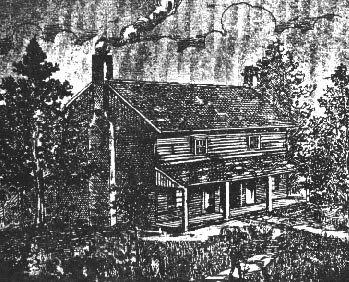
What survives most clearly is the story’s hold on the region. A family name, a rural landscape, an illustrated house, and a cave have become linked in the public imagination.
Would you enter with a guide and a lantern, take the daytime history tour, or stay outside and read the accounts? The attraction’s official pages provide current cave, cabin, and lantern-tour information. Check those details directly before traveling; the cabin discussed in modern tours is a reconstruction, not the original family house.
Keep exploring: Browse all Haunted Country Roads stories · The ghost of Room 18 at the St. James Hotel · Eddie’s firsthand night at Hotel Monte Vista.
Haunted Country Roads is an original Country Road Entertainment series about historic places, local legends, and unexplained experiences along America’s back roads. Reported hauntings are presented as claims, with their sources identified.
Sources and Photo Credits
- Tennessee Encyclopedia — William T. Turner, Bell Witch
- Historic Bell Witch Cave — operator’s history and legend
- Historic Bell Witch Cave — cave and reconstructed cabin tours
- Skeptical Inquirer — Joe Nickell, The Bell Witch Poltergeist
- CRE’s original Facebook feature — October 27, 2026
Photographs are documentary images, not claimed evidence of ghosts. Web copies are proportionally resized and JPEG-optimized; no people, apparitions, architectural features, or purported evidence have been generated or added. Creative Commons photographs retain their stated licenses; individual credits and source links appear above.